
AI Insights Dualmedia to Shape the Future of Content
Introduction
AI Insights Dualmedia has transformed digital content creation by integrating cutting edge artificial intelligence at every step of the publishing pipeline. Their unified platform ingests vast datasets, applies sophisticated algorithmic modeling and optimizes in real time to automate production and personalize audience experiences. For instance The Washington Post’s Heliograf uses AI to generate thousands of routine news updates from Olympic medal tallies to election results freeing journalists to focus on in depth reporting.
Similarly Netflix leverages deep learning and collaborative filtering to serve over 80 percent of its viewed content through hyper-personalized recommendations saving more than $1 billion annually in retention costs. The Associated Press has harnessed natural language generation to automate earnings reports and sports recaps increasing output without expanding staff. By unifying data ingestion, NLG and feedback driven optimization AI Insights Dualmedia enables brands and publishers to scale tailored storytelling and drive engagement across every channel.
Understanding Dualmedia’s Approach to AI
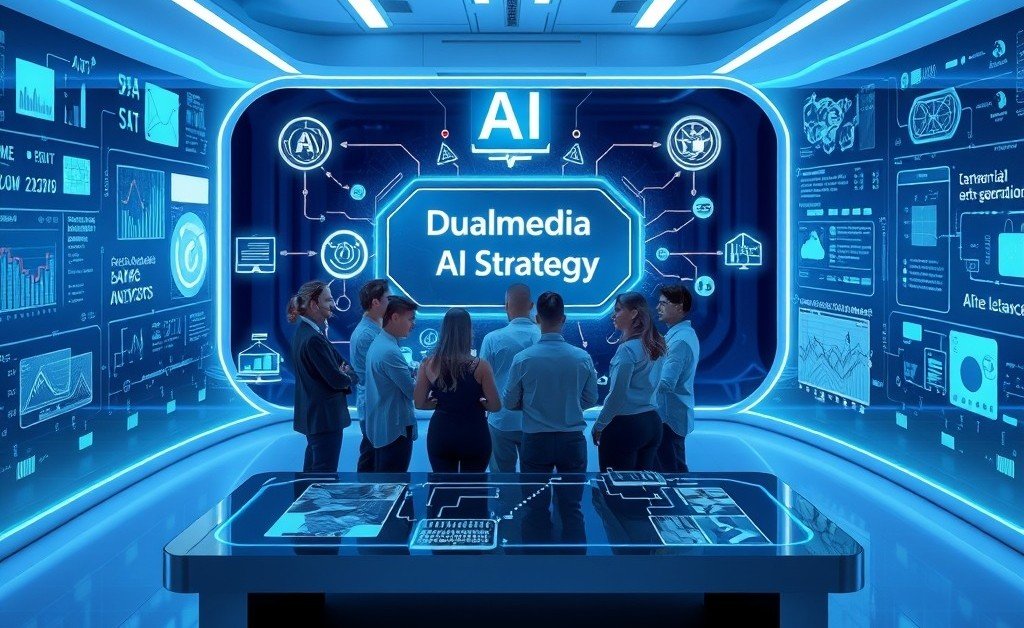
Dualmedia’s end to end solution collects audience behavior, market trends and performance metrics into a centralized data lake. Advanced machine learning models then forecast content success and recommend formats, headlines and distribution channels.
The platform’s closed loop feedback ensures continuous model refinement and precise editorial planning releated to how Netflix leveraged viewer data to greenlight House of Cards and custom tailor its trailers based on user preferences. (U-Next) https://u-next.com/blogs/data-science/how-netflix-used-data-science-to-create-one-of-the-most-loved-shows-ever-house-of-cards/
Top 8 AI Insights Dualmedia Uses:
1. Predictive Content Analytics
Dualmedia employs AI models to forecast which topics, formats and headlines will resonate most with target audiences. By analyzing historical engagement and real time behavior the system predicts content performance allocating resources to ideas with the highest projected ROI.
Example: Netflix used similar predictive analytics to greenlight House of Cards analyzing viewer data to identify appetite for political drama and the draw of talent like Kevin Spacey and David Fincher leading to blockbuster engagement. https://www.geeksforgeeks.org/artificial-intelligence/how-netflix-uses-artificial-intelligence/
2. Natural Language Generation (NLG)
Dualmedia integrates state of the art NLG engines such as those pioneered by IBM Watson and AX Semantics to generate first drafts of articles, meta descriptions and product blurbs. These engines transform structured inputs (data tables or keywords) into coherent, brand aligned prose, slashing writing time and costs.
https://www.ibm.com/think/topics/natural-language-generation
Real-world tool: AX Semantics offers self service NLG modules that produce SEO-optimized blog drafts from data inputs achieving consistency at scale. https://thatware.co/natural-language-generation/
3. Audience Segmentation and Personalization
Dualmedia leverages machine learning to analyze demographic, behavioral and contextual data segmenting users into precise micro audiences. This targeted approach allows the delivery of personalized content tailored to each group’s preferences and needs. Whether through email campaigns, social media posts or on site recommendations the content is customized for maximum relevance. Such fine tuned personalization significantly enhances user engagement and boosts conversion rates.
By continuously learning from user interactions the system refines its targeting strategies over time. This dynamic segmentation ensures content always resonates with individual audiences. Ultimately Dualmedia’s AI driven personalization drives stronger connections and business outcomes.

Industry example: Mailchimp’s AI segmentation analyzes customer journeys to forecast buying patterns and tailor campaigns leading to up to 40% higher revenue for personalized cohorts.
https://mailchimp.com/resources/ai-customer-segmentation/
4. Sentiment Analysis for Editorial Strategy
Dualmedia utilizes advanced natural language processing(NLP) models to analyze the emotional tone in user feedback as well as draft content. This sentiment analysis helps writers understand audience mood, whether it is upbeat, informational or cautious. By aligning messaging with these emotional cues content becomes more engaging and relevant.
This approach enhances audience resonance and builds trust through empathetic communication. Writers can adjust tone dynamically based on real time insights ensuring content meets audience expectations. Ultimately sentiment driven editorial strategies improve connection and effectiveness. Dualmedia’s AI thus supports more impactful and audience centered storytelling.
https://www.ibm.com/think/topics/natural-language-generation
Case in point: IBM Watson Natural Language Understanding performs sentiment and emotion detection on articles and social posts, guiding tone adjustments to optimize audience responses.
5. Real Time Content Performance Tracking

AI dashboards monitor click through rates, dwell time and bounce rates in real time. Automated alerts highlight underperforming content while recommendation engines propose instant adjustments such as headline tweaks or image swaps to engagement mid campaign. This dynamic feedback loop enables teams to react immediately to audience behavior optimizing assets on the fly. Continuous performance tracking ensures campaigns stay agile and effective, maximizing ROI and user satisfaction.
6. Visual Recognition for Media Tagging
Leveraging advanced computer vision Dualmedia’s AI automatically analyzes images and videos to generate rich descriptive metadata. This automated tagging process enhances searchability across vast media libraries, making content discovery instantaneous. By embedding detailed labels such as objects, scenes and contextual cues assets become easily re purposable for diverse campaigns.
Metadata driven organization cuts down on manual cataloging freeing teams to focus on creative strategy.
https://www.geeksforgeeks.org/artificial-intelligence/how-netflix-uses-artificial-intelligence
Live example: Netflix employs automated content tagging to categorize shows by genre, themes and even mood improving discovery and personalized artwork selection.
7. AI Assisted Editing and Optimization

Before publishing content undergoes AI powered quality checks including grammar correction, readability scoring, keyword density analysis and SEO compliance verification. These automated gates ensure the content is polished, clear and optimized for search engines. By catching errors and enhancing structure early the AI reduces the need for extensive manual editing.
This streamlines the review process saving valuable time for content creators and editors. The result is consistently high quality output that aligns with industry best practices. AI assisted editing also adapts to evolving SEO standards keeping content competitive. Overall this approach enhances efficiency while maintaining excellence across all published materials.
https://www.eweek.com/artificial-intelligence/natural-language-processing-tools/
8. Workflow Automation in Content Pipelines

AI drives seamless automation across entire content workflows from formatting articles to scheduling and posting across multiple platforms. It manages end to end processes ensuring timely distribution while maintaining consistency in messaging and branding.
Automated cross channel publishing eliminates repetitive tasks, enabling content to reach diverse audiences efficiently. Additionally AI updates archives and content repositories in real time keeping information current without manual intervention. This holistic orchestration frees teams to concentrate on creative development and strategic planning.
By streamlining operations, AI enhances productivity and accelerates time to market. Ultimately it empowers organizations to scale content efforts with precision and agility.
Impact of These AI Insights on Content Creation
Dualmedia’s AI driven strategies have slashed production time by 60% automating repetitive tasks such as drafting outlines, formatting and metadata generation to free creative for high value work. Real world implementations mirror Team GPT’s “House of Growth” case where AI generated outlines doubled article throughput 80 to 160 per month without headcount increases.

By harnessing predictive workflows, Dualmedia reallocates 85 hours monthly from process tasks back to strategy fostering rapid iteration and enabling campaigns to launch weeks ahead of traditional schedules. The integration of AI pipelines ensures every asset passes through uniform quality checks at scale.
Dualmedia’s personalization engines drive a 30 to 50% uplift in engagement, leveraging real time data to tailor headlines, graphics and recommendations for individual segments. For example: Mailchimp’s cohorts achieved 2× revenue increases through AI segmentation that predicts lifetime value, guiding bespoke email and social tactics.
All content undergoes AI-assisted editing delivering uniform quality across thousands of assets. Trinka’s Language Central demonstrated a 40% reduction in turnaround by auto scoring manuscripts and routing them to appropriate editors ensuring consistent tone and accuracy at scale. Clearscope like SEO gates boost organic traffic by up to 15%, embedding best practices automatically.
AI driven pipelines enable 10× scalability supporting tenfold content volumes without proportional headcount growth. Matrix Marketing estimates over 75% of businesses will adopt AI for content creation by 2025 and in future as automation tools shoulder increasing workloads letting small teams drive enterprise level output (https://matrixmarketinggroup.com/2025-ai-driven-case-studies/).
Dualmedia’s Competitive Edge with AI Integration

Dualmedia’s unified AI backbone spans ideation, creation, distribution and performance analysis forming a seamless lifecycle where insights at one stage inform subsequent optimizations. Its predictive analytics surface high ROI topics much like Netflix’s data driven greenlighting of House of Cards based on 30 million plays and search trends investment in content that resonates.
Through platform-specific optimization, Dualmedia customizes formats and delivery for web, social and email channels related to Mailchimp’s AI powered customer journeys that yielded 40% higher revenue for personalized cohorts(https://www.wsiworld.com/blog/personalization-engagement-the-power-of-hyper-targeted-marketing/). Each touchpoint leverages proprietary AI models to maximize engagement metrics.
Its end-to-end automation accelerates turnaround by 50% orchestrating formatting, tagging, scheduling and distribution across CMS and social platforms without manual handoffs(https://team-gpt.com/blog/15-real-world-examples-of-ai-automation-in-2025/). AI powered A/B tests refine headlines and CTAs on the fly embodying a data informed creative process.
Challenges and Considerations
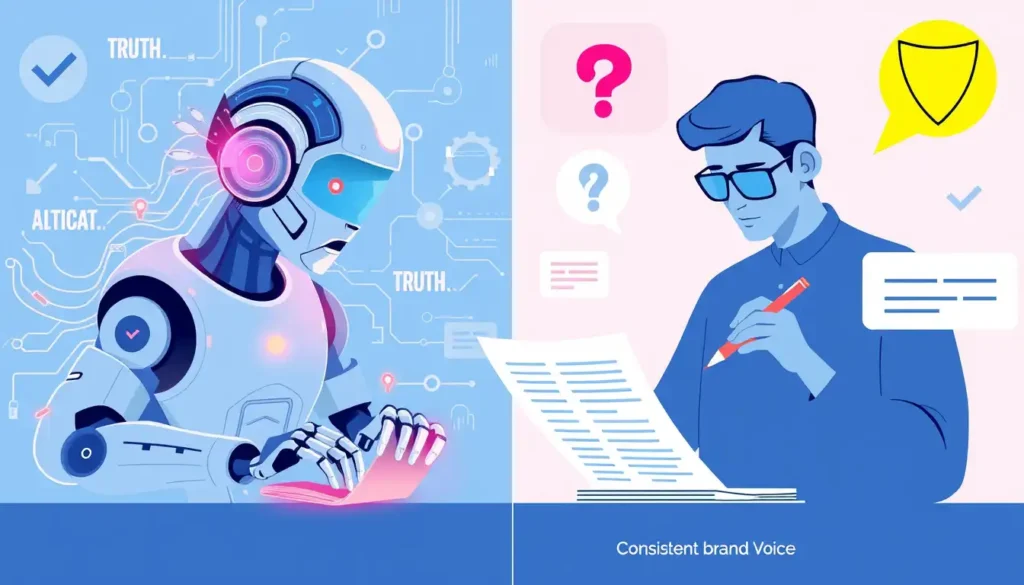
Integrating AI raises ethical and authenticity concerns: ensuring factual accuracy avoiding “AI hallucinations” and preserving brand voice. EasyContent advises rigorous fact checking and human oversight to mitigate inaccuracies(https://easycontent.io/resources/best-practices-for-editing-ai-content/).
Balancing automation with creativity is critical while AI drafts expedite production, human editors inject nuance and original insights an approach supported by journalism studies showing AI as a “creative springboard” rather than a replacement(https://arxiv.org/html/2502.05347v1).
Data privacy and compliance demand vigilant governance: collecting, storing and processing user data under evolving regulations like GDPR and CCPA. Dualmedia’s human in the loop model ensures AI outputs are reviewed by experts before publishing to uphold ethical standards.
Conclusion
Dualmedia’s strategic deployment of predictive analytics, NLG, personalization, sentiment analysis, vision tagging, AI editing and automated pipelines is reshaping digital content creation. By coupling advanced AI with human oversight they deliver faster more personalized and consistently high quality content at unprecedented scale. As organizations embrace AI success will hinge on holistic integration embedding AI ethically and creatively across every content touchpoint.
FAQ’s
What is an AI insight?
AI insights refer to valuable, data-driven observations or predictions generated by artificial intelligence systems, helping businesses make informed decisions.
Which is the best AI for insights?
The best AI for insights depends on specific needs, but popular choices include IBM Watson, Google Cloud AI, and Microsoft Azure AI, known for their robust analytics and predictive capabilities.
What is the alternative to Zebracat AI?
An alternative to Zebracat AI could be platforms like DataRobot, H2O.ai, or RapidMiner, offering similar AI-driven analytics and predictive modeling capabilities.
Do digital twins use AI?
Yes, digital twins utilize AI to simulate, analyze, and optimize real-world processes or systems, enhancing decision-making and operational efficiency.
What are the 4 types of digital twins?
The four types of digital twins are: (1) digital twin prototype, (2) digital twin instance, (3) digital twin aggregate, and (4) digital twin system of systems.