Artificial General Intelligence Book: A Complete Guide
Artificial General Intelligence Book is a term gaining massive traction in academic and tech communities. As the field of artificial intelligence (AI) continues to grow rapidly, the discussion around AGI—Artificial General Intelligence—is becoming increasingly crucial.
Unlike narrow AI systems designed to perform specific tasks, AGI aims to replicate human-level intelligence capable of general reasoning and learning. A comprehensive artificial general intelligence book serves as a gateway for students, researchers, engineers, and enthusiasts to understand the deep theoretical and practical underpinnings of AGI.
In this article, we’ll explore what an Artificial General Intelligence book typically includes, examine some of the most important titles in the field, break down key concepts they cover, and look at how AGI literature is shaping the future of human-machine collaboration.
Understanding Artificial General Intelligence

Artificial General Intelligence refers to machines with the ability to learn and perform any intellectual task a human can do. AGI is different from narrow AI (ANI) or even superintelligent AI (ASI) because it strives for flexibility, adaptability, and self-improvement.
AGI combines various branches of computer science, cognitive science, neuroscience, linguistics, and philosophy. Literature on AGI typically covers the following topics:
- Machine learning and deep learning
- Natural language understanding
- Neural network architectures
- Human cognition modeling
- Reinforcement learning
- Consciousness and ethics
An Artificial General Intelligence book doesn’t just explain these ideas—it integrates them into a framework for building truly autonomous systems.
Essential Artificial General Intelligence Books
Here are some foundational texts and popular books that anyone serious about AGI should read:
1. “Artificial General Intelligence” – Ben Goertzel & Cassio Pennachin
One of the most cited AGI books. It lays down the philosophical, technical, and cognitive basis for AGI. It also proposes the OpenCog framework for general intelligence.
2. “Superintelligence: Paths, Dangers, Strategies” – Nick Bostrom
Though not entirely focused on AGI development, it explores the ethical and existential implications of general intelligence exceeding human intelligence.
3. “The Emotion Machine” – Marvin Minsky
A deep dive into how emotions and cognition intersect in intelligent systems, proposing that emotional responses are central to general intelligence.
4. “How to Create a Mind” – Ray Kurzweil

Explores the mechanics of human thought and proposes models that could be adapted into AGI development, especially the hierarchical hidden Markov models.
5. “On Intelligence” – Jeff Hawkins
Another classic focusing on the neocortex’s structure and how its principles can be applied in general AI systems.
What Do These Books Teach?

Artificial General Intelligence books share core themes:
1. Human Cognition as a Model
Many AGI texts stress that human intelligence is the ultimate template. Understanding memory, attention, reasoning, and learning is critical.
2. Unified Theory of Intelligence
Books like Goertzel’s discuss systems that can synthesize multiple forms of learning and reasoning in a single framework.
3. Ethical and Philosophical Challenges

Topics like machine morality, consciousness, and free will frequently appear. AGI raises new ethical frontiers.
4. Learning Beyond Data
Unlike narrow AI that relies on massive datasets, AGI aims to learn from minimal input and generalize across domains.
5. Long-Term Vision
Books often conclude with future scenarios, risks of misuse, and AGI’s role in society 50 or 100 years ahead.
Why Read an Artificial General Intelligence Book?

There are multiple reasons to dive deep into AGI literature:
- Technical Understanding: Grasp complex models like cognitive architectures and hybrid AI systems.
- Future Forecasting: Anticipate shifts in society, economy, and geopolitics driven by AGI.
- Research Directions: Discover unanswered questions and become part of the AGI research ecosystem.
- Ethical Awareness: Prepare for policy-making and social responsibility in a world with intelligent machines.
- Inspiration for Innovation: Many startups and tech breakthroughs are based on ideas first explored in AGI books.
Artificial General Intelligence in Academia and Research
Universities and institutes are now integrating AGI into their research programs:
- MIT Media Lab: Working on hybrid intelligence combining human and machine thinking.
- Stanford AI Lab: Exploring memory and perception in neural architectures.
- OpenAI & DeepMind: Advancing general learning agents.
- SingularityNET: Led by Ben Goertzel, working on decentralized AGI systems.
Books produced by these institutions or their scholars are typically peer-reviewed, data-driven, and influence the next wave of AI innovation.
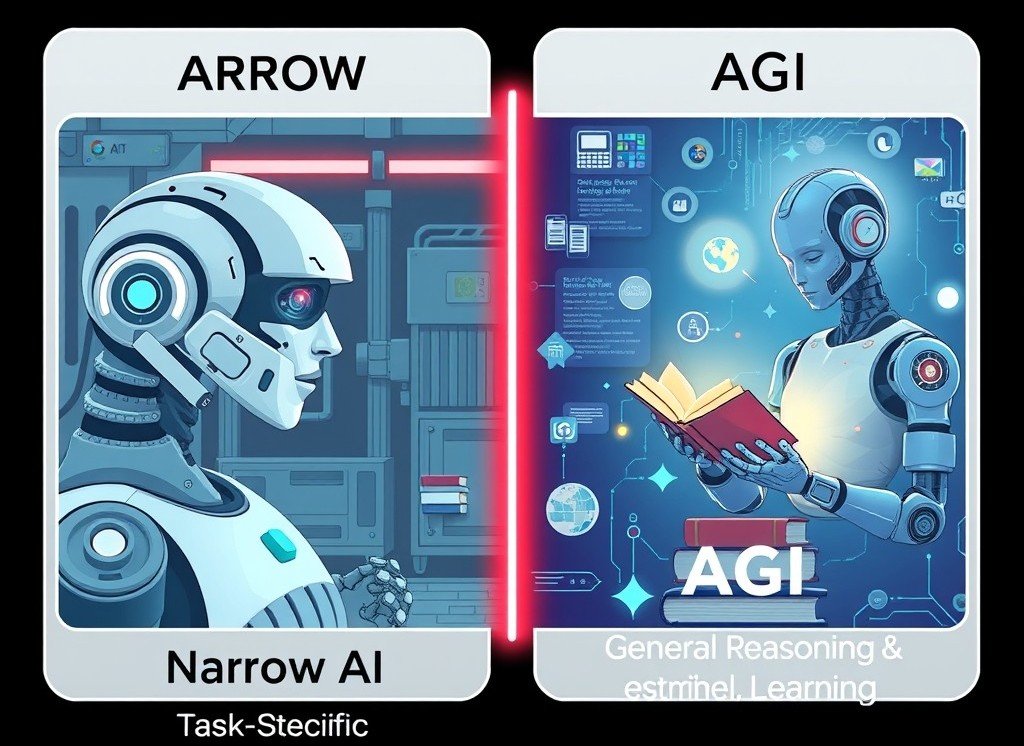
AGI vs. Narrow AI: A Literary Comparison
| Feature | Narrow AI | AGI Books Promote |
|---|---|---|
| Scope | Specific tasks (e.g., image recognition) | General reasoning, learning |
| Learning | Supervised or unsupervised | Flexible, context-based |
| Adaptability | Limited | Highly adaptable |
| Consciousness | None | Discussed as a future possibility |
This comparison helps highlight the scope AGI books strive to define—moving far beyond the confines of current machine learning.
AGI Book Authors: Key Voices to Follow
- Ben Goertzel: Philosopher, AI researcher, and founder of SingularityNET.
- Nick Bostrom: Thinker on AI safety, governance, and long-term ethics.
- Ray Kurzweil: Futurist at Google, known for work on mind-machine merging.
- Marvin Minsky: Co-founder of MIT’s AI Lab, pioneer in AI theory.
- Jeff Hawkins: Neuroscientist turned technologist; emphasizes biology-driven AI.
These authors shape the way the world understands AGI through their books, lectures, and interviews.
Reading for Different Audiences

AGI literature spans various difficulty levels:
- For Beginners: “On Intelligence,” “How to Create a Mind”
- For Intermediates: “The Emotion Machine,” “AGI Revolution”
- For Experts: “Artificial General Intelligence” (Goertzel), research anthologies, and journal papers
Choose the right book based on your background in computer science, neuroscience, or philosophy.
The Role of Artificial General Intelligence Books in Shaping Policy
AGI literature is not confined to academia. Policymakers, entrepreneurs, and educators refer to these books to:
- Inform AI ethics regulations
- Design safe AI development roadmaps
- Influence educational curricula in cognitive computing
- Address labor market disruptions from automation
Books like Bostrom’s “Superintelligence” have been cited in global government AI reports.
Conclusion
Artificial General Intelligence books provide critical insights into the next frontier of AI. They combine multidisciplinary theories, advanced technical architectures, and real-world implications into accessible and authoritative texts. Whether you’re aiming to build intelligent machines or just want to understand their impact, these books are essential tools.
FAQ’s
Q1: What is the best book to learn about Gen AI?
A: “AI 2041” by Kai-Fu Lee offers engaging stories and expert insights into the future of General AI. It combines fiction with real-world AI analysis.
Q2: What is the best book to start with AI?
A: “Artificial Intelligence: A Guide for Thinking Humans” by Melanie Mitchell is an excellent beginner-friendly introduction. It explains core concepts without heavy technical jargon.
Q3: Is ChatGPT ANI or AGI?
A: ChatGPT is an Artificial Narrow Intelligence (ANI). It performs specific tasks and doesn’t possess general human-like intelligence.
Q4: What is the best AI program for beginners?
A: Google Teachable Machine is beginner-friendly and requires no coding. It’s great for learning basic AI concepts through hands-on experiments.
Q5: What is the best AI book creator?
A: BookBolt uses AI to help create and format books for Kindle and print. It’s ideal for self-publishing beginners and authors.